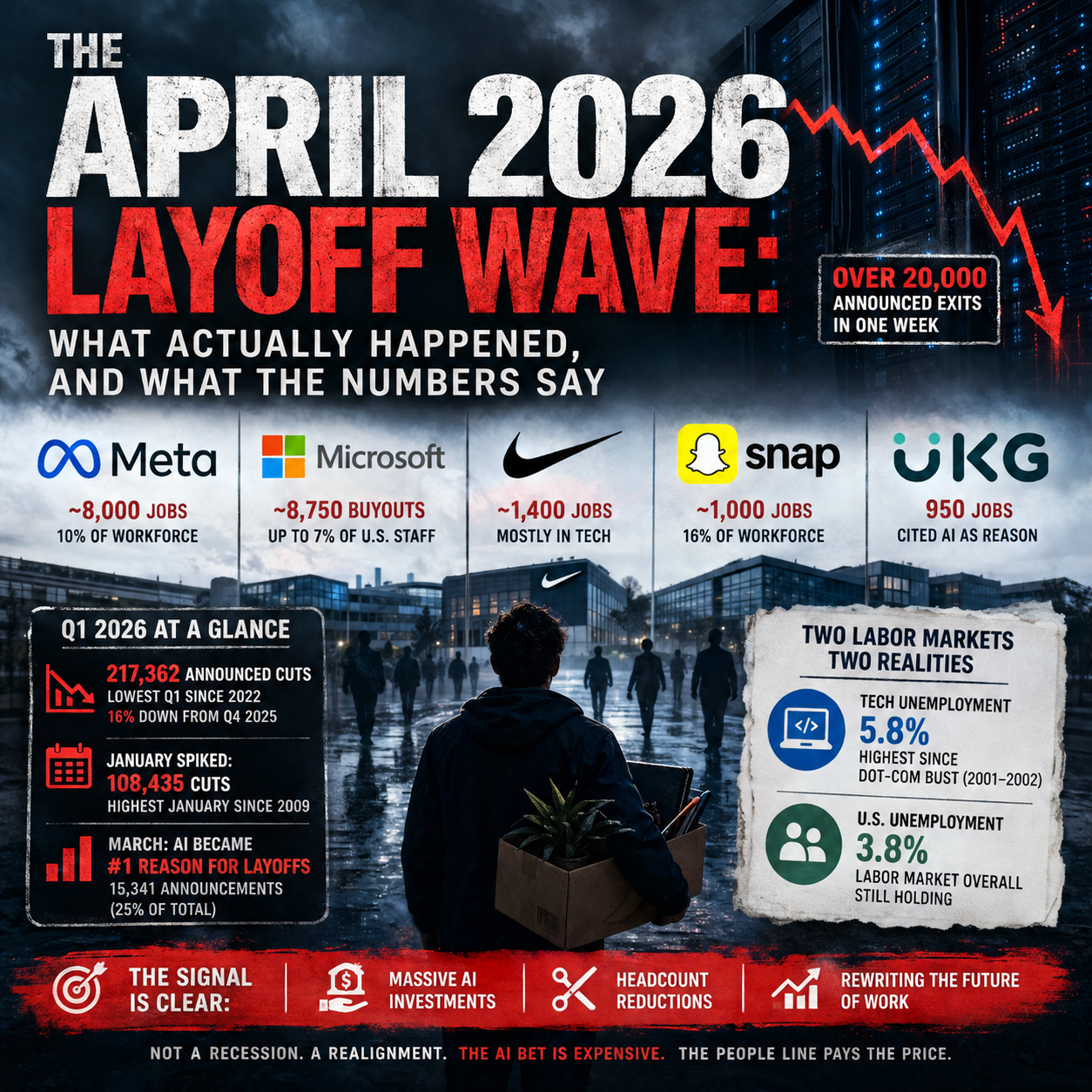
April 2026 layoff wave summary: Meta 8,000, Microsoft 8,750 buyouts, Nike 1,400, Snap 1,000, UKG 950 — over 20,000 announced exits in one week

The April 2026 Layoff Wave: What Actually Happened, and What the Numbers Say

By Vikas Bansal, founder, CV-BY-JDUpdated Apr 27, 202610 min read

Affected by this? Run your resume against any job description in under a minute.

Free ATS Checker →

The April 2026 Layoff Wave: What Actually Happened, and What the Numbers Say

For about 36 hours, between Wednesday morning and Thursday night, three of America's largest employers announced they were cutting people. Meta. Microsoft. Nike. Different industries, different reasons in their press releases, the same news cycle.

I started looking into this expecting another "tech is laying off again" story. The data turned out to be more interesting than that — and a little more uncomfortable.

Here's what's actually happened over the past few weeks, what the numbers say, and where the lines are starting to cross.

Visual summary: March was the heavy month (Oracle, Epic, Pinterest, Peloton). April was the cluster (Meta, Microsoft, Nike, Snap, UKG). Tech-sector unemployment 5.8% vs U.S. overall 3.8%. Capital spending on AI infrastructure converting payroll into capex.

A strange Q1, and an even stranger April

The Challenger, Gray & Christmas job cut report — the closest thing the U.S. has to a real-time layoff tracker — has Q1 2026 at 217,362 announced cuts. That's the lowest first quarter since 2022, and down 16% from Q4 2025.

So if Q1 was actually quieter than 2025, why does it not feel quieter?

Two reasons.

First, the year started loud. January alone saw 108,435 cuts, the highest January since 2009. That number anchored the narrative early. February calmed down (48,307), then March crept back up (60,620 — about a 25% jump from February). Most people remember January and forget what came after.

Second, the cuts have been shaped weirdly. The size of the layoff isn't what's getting attention right now — it's the names attached to them.

Tech-sector unemployment, which has its own story separate from the headline U.S. number, has climbed to 5.8% in early 2026, per Bureau of Labor data summarized by InformationWeek and Tom's Hardware coverage. That's the highest tech-specific unemployment rate since the dot-com bust of 2001–2002. The overall U.S. unemployment rate, by contrast, is still hovering around 3.8%.

Two job markets, in other words. One that looks fine on paper. One that doesn't.

March: the month that ended at 6 a.m.

If April's been the noisy month, March was the heavy one.

On Monday, March 31, somewhere between 5 and 6 a.m. local time across the United States, India, Canada, and Mexico, an unknown number of Oracle employees — credible reporting from CNBC, Yahoo Finance, and The Next Web puts it at up to 30,000 — opened their inboxes to find an email from "Oracle Leadership" telling them their roles had been eliminated. That same morning was their last working day. No advance HR notice. No manager call.

The figure works out to roughly 18% of Oracle's global workforce.

Oracle didn't publicly explain the cuts in detail, but the financial context is hard to miss. The company has committed to an AI infrastructure buildout that TD Cowen has estimated at around $156 billion in capital spending. Capex for fiscal 2026 alone has been guided at roughly $50 billion — about $15 billion more than what Oracle had told Wall Street only a few months earlier. To get there, Oracle has reportedly taken on around $58 billion in new debt within two months, and several U.S. banks have stepped back from financing parts of the project.

That's the backdrop. A profitable company posting roughly $6 billion in quarterly net income laid off tens of thousands of people because the spreadsheet for the next decade requires more cash than the spreadsheet for last quarter could supply.

The same week, on March 24, Epic Games announced about 1,000 layoffs. CEO Tim Sweeney explicitly told staff this one wasn't AI-driven. It was Fortnite — engagement was down, costs were running ahead of revenue, and the company needed to fund itself differently. Worth flagging, because in a season when "AI" is being attached to almost every layoff press release, here was an executive going out of his way to say it wasn't.

Earlier in March, Pinterest announced a global restructuring affecting under 15% of staff, framed publicly as part of an "AI-forward" pivot. Peloton trimmed roughly 11% as part of a previously announced plan to save $100 million by the end of fiscal 2026.

Outside of tech, Algoma Steel laid off about 1,000 people on March 23. Tariff-related restructuring across industrial supply chains has been chewing through North American manufacturing payrolls all spring, even when individual stories haven't hit national news.

April: the cluster

Now to the days that turned the layoff conversation into a labor-market conversation.

On April 15, Snap announced it was cutting about 16% of its full-time workforce — roughly 1,000 people. CEO Evan Spiegel told staff that AI tools had let "small squads" make outsized progress, and that the company was reorganizing around that observation. The same memo said Snap was pulling listings for 300+ open roles. Spiegel's filing language put the savings at over $500 million on an annualized basis by the back half of 2026. Investors apparently liked it. Snap's stock jumped on the news.

A week later, on April 21, UKG — the workforce-management company owned by Blackstone — laid off 950 employees, citing AI as the reason. UKG sells software that helps other companies manage their own headcount, which gave the announcement a layer of irony nobody enjoyed.

Then came the cluster.

On April 23, Meta told employees in a companywide memo that it would cut about 8,000 jobs — roughly 10% of its workforce — with the layoffs taking effect on May 20. According to Variety, CNBC, and CNN's coverage, Meta is also closing about 6,000 open roles that had been on its hiring plan, taking more than 14,000 positions out of its 2026 headcount math. The reason given internally was almost mechanical: the company spent $72.2 billion on capital expenditures in 2025, mostly on AI data centers and infrastructure, and is guiding for at least $115 billion in 2026. Mark Zuckerberg's January memo had hinted this was coming, calling 2026 "the year that AI starts to dramatically change the way that we work."

The same day, in what was almost certainly not a coincidence of timing, Microsoft announced something it has never done in its 51-year history: a voluntary buyout for U.S. employees. Per CNBC and TechCrunch reporting, the program is open to up to 7% of the U.S. workforce — about 8,750 people. Eligibility is restricted to staff at senior director level and below whose age plus tenure adds up to 70 or more. Affected employees get the formal details on May 7.

It's worth pausing on this. Microsoft has chosen to exit thousands of long-tenured employees through a structured retirement-style offer rather than through layoffs. That's a deliberate choice. It avoids WARN notices, severance disputes, and the usual layoff PR cycle. It also lets Microsoft tell investors it's reshaping headcount around AI without telling the labor market it's "cutting" anyone — at least not publicly. The cost saving lands in the same place; the headline doesn't.

A day later, Nike confirmed about 1,400 cuts globally, mostly in technology, mostly across Beaverton and the Nike India Technology Center. This was Nike's second 2026 layoff round, following 775 cuts in January. The official line is that this is part of a "Win Now" turnaround strategy: consolidate tech operations into two hubs, simplify supply-chain teams, modernize Air manufacturing. Internally and externally, the Bloomberg framing is harder-edged — Nike is a profitable, well-known consumer brand letting go of corporate technology staff, and that detail is what's getting picked up across HR media.

If you stack just the headline numbers from a single April week — Snap (~1,000), UKG (~950), Meta (~8,000), Microsoft (~8,750 buyouts), Nike (~1,400) — you're already past 20,000 announced exits, plus the additional headcount Meta is taking off the table by closing open roles.

Where the money is actually going

The press releases tend to use words like "efficiency," "streamlining," and "AI-driven workflows." Translated, most of them describe the same trade.

Capital spending on data centers, GPUs, and AI infrastructure has gone from a large line item to the dominant line item across hyperscalers and large tech companies. Meta's number is going from $72B to a $115B+ run rate. Microsoft's data-center investments are widely reported in the $80B+ range for the fiscal year. Oracle has signaled $50B in fiscal-2026 capex against an estimated $156B multi-year buildout.

That money has to come from somewhere. Public companies don't have unlimited room to push capex up while keeping operating margins stable. So payroll, one of the largest operating expense lines for any tech company, gets converted — directly or indirectly — into capacity for AI infrastructure.

That's the unromantic version of "AI is taking jobs." It's not (mostly) that an AI agent is doing what the laid-off employee did. It's that the company has decided to spend the next decade buying AI capacity, and the only way to fund that without spooking the market is to take cost out of the people line.

That doesn't mean AI substitution isn't happening at all — Snap's framing about "small squads" is a real claim, and engineering productivity tooling has measurably changed how many people you need on certain projects. But for most of the cuts in the past two months, the money story is more visible than the substitution story.

Two narratives, one labor market

The Challenger data is useful here because it tries to attribute reasons.

For the full Q1 2026, the leading reasons for announced cuts were Market and Economic Conditions (45,103), Restructuring (37,916), Closings (37,405), Contract Loss (31,817), and AI (27,645) — AI fifth overall.

But for March specifically, the picture flipped. AI became the #1 stated reason for cuts that month, at 15,341 announcements — about 25% of the March total. April will be the next data point worth watching closely; based on the language coming out of Meta, Microsoft, Snap, and UKG, the "AI" share looks likely to climb again.

Both stories are true. The U.S. labor market overall isn't in a recession. JOLTS data through February showed roughly 6.9 million job openings — softer than the post-pandemic peak, but not collapsed. NFIB's small-business surveys still show a meaningful share of small employers reporting they can't fill positions.

The tech labor market is a different animal. A 5.8% sector unemployment rate, multiple Fortune 100 tech firms running concurrent reductions, and hiring plans being trimmed alongside actual layoffs (Meta closing 6,000 open roles, Snap closing 300+) means the market for senior tech roles in particular is structurally tighter than the U.S. headline number suggests.

Outside of tech, the cuts look more conventional. Retail, manufacturing, healthcare, and entertainment have all logged layoffs in 2026, but the framing is generally restructuring or cost discipline rather than AI substitution.

What seems to be coming next

A few things are sitting on the calendar.

May 7 — Microsoft formally communicates buyout details to eligible employees. Expect a second wave of Microsoft news depending on how many people accept.

May 20 — Meta's 8,000 layoffs take effect. Meta has also flagged that further layoffs are likely in the second half of 2026 as it absorbs its AI capex commitments.

Sometime in May — the BLS releases JOLTS data for March 2026 (scheduled May 5) and the Challenger report for April. The April Challenger number will probably tell us, with hard data, whether the cluster we just lived through was an unusual week or the start of a new run rate.

Q2 earnings season, which kicks off in mid-July, will be the next checkpoint. If hyperscaler capex guides keep climbing, the labor adjustment is unlikely to stop in May. If they soften, it might.

Reading the signal, not the noise

The noisy version of this story — "AI is replacing jobs" — is partially true and partially a press-release convenience. AI is replacing some work. AI capex is, more importantly, eating budgets that used to fund headcount. Those are related forces, but they're not the same force, and conflating them makes the situation harder to think about clearly, not easier.

If you work in tech right now, three things look fairly stable in the data:

The companies cutting hardest are the ones with the largest AI infrastructure commitments. That's Meta, Oracle, Microsoft, and a long tail of medium-sized public software companies whose cost structures don't have room for both their existing headcount and their AI ambitions.

Roles closer to operations and traditional corporate functions — IT support, internal tools engineering, supply-chain coordination, marketing operations — appear to be more exposed than roles directly tied to revenue or to AI build-out itself.

And the U.S. labor market is still adding net jobs, even while specific industries shed them. The March 2026 jobs report (per Robert Half's summary) had nonfarm payrolls up by roughly 178,000. That's not a depression number. It's also not a "tech is fine" number.

Both can be true. They are.

What April 2026 actually showed isn't that the bottom fell out. It's that several of the largest tech employers in the world made the same decision in roughly the same week — and the financial logic behind their decisions is going to keep playing out for at least the rest of the year.

Sources and further reading

  • Challenger, Gray & Christmas — March 2026 Job Cut Report and Q1 2026 totals
  • CNBC — Oracle layoffs (March 31), Microsoft voluntary buyout (April 23), Meta layoffs (April 23), Nike layoffs (April 23), Snap layoffs (April 15)
  • Variety, CNN Business, CBS News — Meta 8,000 layoff coverage
  • TechCrunch, Bloomberg — Microsoft 7% buyout details
  • The Next Web, Yahoo Finance, WSWS — Oracle workforce reduction reporting
  • PBS NewsHour, Game Developer — Epic Games 1,000-person cut and Tim Sweeney's memo
  • Tom's Hardware, InformationWeek — Q1 2026 tech sector layoff totals and unemployment
  • U.S. Bureau of Labor Statistics — JOLTS February 2026 release
  • Robert Half — March 2026 jobs report summary
  • Deadline, Fast Company — Snap 16% workforce reduction, AI framing

All figures are based on publicly reported announcements and the most recent labor data available at the time of writing.

Share:X/TwitterLinkedIn