Resume Strategies After Layoffs: How to Update, Rebuild, and Get Hired Fast
Between January 2023 and December 2025, over 550,000 tech workers were laid off globally — and the cuts didn't stop at tech. Retail, media, finance, healthcare, and manufacturing have all joined the restructuring wave as companies accelerate AI automation and respond to ongoing economic uncertainty.
Nearly 60% of employers confirmed plans for further layoffs through 2026, according to a StaffingHub survey. And 78% of workers fear losing their jobs to AI-driven changes, per the MyPerfectResume workplace trends report — a figure that has only grown as agentic AI tools enter the workplace in 2026.
If you've been laid off — or you think it might be coming — the most productive thing you can do right now is rebuild your resume. Not next week. Now.
Here's the system.
Step 1: Address the Layoff Directly on Your Resume
The worst thing you can do is pretend the layoff didn't happen. Recruiters will notice the gap, and silence creates doubt. According to a CareerBuilder survey, 58% of recruiters specifically look for explanations of employment gaps — and unexplained gaps are one of the top reasons applications get deprioritized.
How to Note the Layoff
Add a brief, factual parenthetical after your most recent role:
Senior Product Manager — Acme Corp
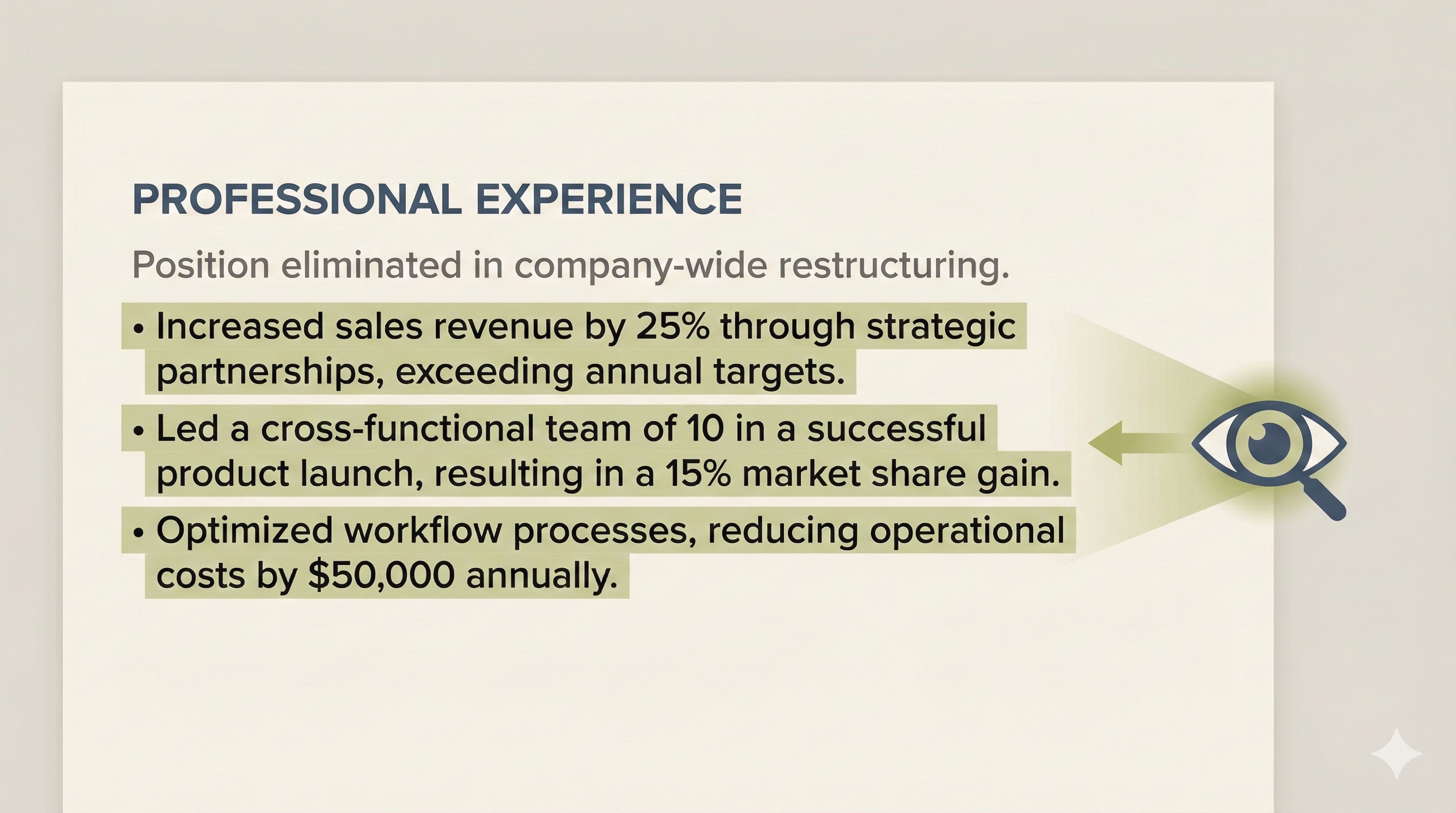
June 2021 – October 2025 (Position eliminated in company-wide restructuring)
Or if the entire division was shut down:
Data Engineer — TechStartup Inc.
March 2022 – August 2025 (Division sunset; company reduced workforce by 30%)
What This Accomplishes
- Removes ambiguity. The recruiter knows immediately it wasn't performance-related.
- Normalizes the situation. Mass layoffs are common enough in 2024–2026 that most hiring managers don't view them negatively — but they do view unexplained gaps with suspicion.
- Shows professionalism. A brief, neutral explanation signals maturity and self-awareness.
What to Avoid
- Don't write a paragraph about the layoff. One line is sufficient.
- Don't use emotional language ("unfortunately let go," "devastating restructuring"). Keep it factual.
- Don't blame the company. Even if the layoff was poorly handled, your resume isn't the place to litigate it.
- Don't hide it. If the recruiter discovers the gap through a reference check or LinkedIn review, the omission looks worse than the layoff itself.
Step 2: Lead With Achievements, Not the Departure
Immediately after the layoff note, your resume should hit hard with what you accomplished in that role before the cut. This is the pivot point — you shift the reader's attention from "this person was laid off" to "this person delivered real results."
The Before/After Framework
Weak (focuses on the gap):
Senior Analyst — FinCorp (Laid off August 2025)
- Performed data analysis
- Created reports for management
- Attended cross-functional meetings
Strong (focuses on impact):
Senior Analyst — FinCorp
January 2022 – August 2025 (Role eliminated in org-wide restructuring)
- Built automated forecasting model that predicted quarterly revenue within 3.2% accuracy, replacing a manual process that required 40+ analyst-hours per cycle
- Reduced reporting turnaround from 5 days to 6 hours by migrating legacy Excel workflows to Python/Pandas pipeline with Tableau dashboards
- Identified $1.2M in cost savings through vendor spend analysis, presented findings to CFO, secured approval for renegotiation
Achievement Mining: Questions to Ask Yourself
If you're struggling to quantify your accomplishments, work through these prompts:
- Revenue impact: Did you help close deals, launch products, or grow accounts? What were the dollar amounts?
- Cost savings: Did you reduce spending, improve efficiency, or eliminate waste? By how much?
- Time savings: Did you speed up a process? From how long to how long?
- Scale indicators: How many people, projects, clients, or dollars were you responsible for?
- Quality improvements: Did you reduce errors, increase satisfaction scores, or improve compliance metrics?
- Firsts: Were you the first person to do something at the company? Launch a new product? Enter a new market? Build a new team?
Most people undercount their achievements by 50–70%. Spend 30 minutes with these questions and you'll have more material than you need.
Step 3: Showcase New Skills and Upskilling
A layoff gap that shows pure inactivity is concerning. A layoff gap that shows learning and initiative is actually a positive signal to employers.
Why This Matters Now More Than Ever
The World Economic Forum's 2025 Future of Jobs Report estimates that 44% of workers' core skills will be disrupted in the next five years. StaffingHub's layoff survey found that jobs lacking AI-adjacent skills are disproportionately targeted for cuts. The message is clear: upskilling isn't optional — it's survival.
What to Include on Your Resume
Certifications completed during the gap:
- Google Data Analytics Professional Certificate (Coursera, completed November 2025)
- AWS Solutions Architect Associate (December 2025)
- HubSpot Inbound Marketing Certification (October 2025)
- Project Management Professional (PMP) — exam scheduled March 2026
Freelance or consulting work:
Freelance Marketing Consultant (September 2025 – Present)
- Developed SEO strategy for 3 small business clients, increasing organic traffic an average of 65% in 90 days
- Built and managed Google Ads campaigns with combined monthly spend of $12K, achieving 4.1x ROAS
Volunteer or pro bono projects:
Volunteer Data Analyst — Local Food Bank (October 2025 – Present)
- Analyzed donor retention data for a nonprofit serving 15,000 families annually
- Created dashboard tracking donation patterns, enabling targeted outreach that increased recurring donors by 23%
Self-directed learning:
- Completed 120+ hours of AI/ML coursework (fast.ai, Andrew Ng's Deep Learning Specialization)
- Built 3 portfolio projects demonstrating Python, SQL, and Tableau skills (GitHub portfolio link)
How to Format It
Create a dedicated section on your resume:
PROFESSIONAL DEVELOPMENT (October 2025 – Present)
- AWS Solutions Architect Associate Certification
- Google Analytics 4 Advanced Implementation Course
- Freelance marketing consulting: 3 clients, $12K monthly ad spend managed, 4.1x average ROAS
- Built open-source inventory forecasting tool (Python/FastAPI) — 200+ GitHub stars
This section goes directly after your most recent employment and before older roles. It fills the gap chronologically and demonstrates forward momentum.
Step 4: Tailor Aggressively for Every New Application
Here's where most recently laid-off job seekers make their biggest mistake: they send the same resume everywhere because they're in a rush to apply broadly.
The data says this backfires.
The Volume vs. Quality Trade-Off
| Strategy | Callback rate | Applications needed | Time to first interview |
|---|---|---|---|
| Generic resume, mass applications | 2–4% | 80–120 | 8–12 weeks |
| Manually tailored per job | 12–18% | 30–50 | 3–5 weeks |
| AI-assisted tailoring (CV by JD) | 18–25% | 15–25 | 1–3 weeks |
When you've been laid off, speed matters. Every week without income increases financial and psychological pressure. But speed without targeting is just busy work that generates rejection emails.
How AI Tools Compress the Timeline
With CV by JD, the post-layoff resume rebuild workflow looks like this:
- Upload your existing resume (even if it's outdated — the AI extracts your core experience)
- Paste the job description for your target role
- The AI does three things automatically:
- Extracts every keyword, skill, and requirement from the JD
- Identifies gaps between your resume and the posting
- Generates a tailored version with ATS-optimized formatting and keyword integration
- You review, edit for authenticity, and submit — total time: 3–5 minutes per application
For someone applying to 20–30 targeted roles, that's 1–2.5 hours of total resume work versus 10–15 hours of manual customization.
When you're laid off and every day counts, that time difference is the difference between interviewing in week 1 and interviewing in week 6.
Rebuild your resume fast with CV by JD — free to start →
Step 5: Reframe Your Narrative for Interviews
Your resume gets you in the door. Your narrative about the layoff determines what happens next. Here are three battle-tested framings:
The Company Story (Best for Mass Layoffs)
"Our entire division was restructured as part of a company-wide shift to [AI/new business model/cost reduction]. I'm proud of what we built — we [specific achievement]. Now I'm looking for a team where I can apply those same skills to [target company's challenge]."
The Growth Story (Best for Individual Layoffs)
"My role was eliminated when the company consolidated [function] into a single team. During my time there, I [specific achievement with metrics]. I've used the transition to [upskilling/certifications/freelance], and I'm targeting roles where I can combine my core experience with these new capabilities."
The Forward Story (Best for Career Pivoters)
"The layoff was the push I needed to pursue [target field], which I've been building toward for [timeframe]. I've already [certification/project/freelance work in new field], and my background in [previous field] gives me a unique perspective on [how it applies to target role]."
Rules for All Three
- Lead with what you accomplished, not what happened to you
- Include one specific metric from your most recent role
- Bridge to what you're looking for next
- Keep the layoff explanation to 1–2 sentences maximum
- Never badmouth your former employer
The Post-Layoff Resume Timeline
Day 1 (2 hours)
- Export your work metrics, performance reviews, project summaries (check device policy first)
- Write down every quantified achievement you can remember — aim for 15–20
- Update your LinkedIn headline and "Open to Work" settings
- Ask 2–3 former colleagues for LinkedIn recommendations while the work is fresh
Days 2–3 (3 hours)
- Build your "master resume" — the comprehensive document with every achievement, skill, and credential
- Identify 3 target role categories and find 5–10 job descriptions for each
- Highlight the most common keywords across those postings
- Use AI tooling to generate tailored versions for your top 10 priority applications
Days 4–7 (1 hour/day)
- Submit 3–5 tailored applications per day to your highest-priority targets
- Track every application in a spreadsheet: company, role, date applied, keywords matched, response
- Begin outreach to hiring managers on LinkedIn (warm intros > cold messages)
- Start your upskilling plan: enroll in one high-value certification relevant to your target roles
Weeks 2–4 (30 min/day)
- Continue submitting 3–5 tailored applications per day
- Follow up on applications submitted in week 1 (1 follow-up email, 7–10 days after applying)
- Analyze your tracking data: which keyword sets are generating callbacks? Which role types?
- Adjust your resume based on callback patterns — more of what works, less of what doesn't
Industries Cutting Jobs in 2026: Where to Watch
Understanding where layoffs are happening helps you prepare — and spot opportunity in adjacent sectors that are hiring.
Currently Cutting (as of Early 2026)
- Tech: Ongoing restructuring as AI automates middle-management, content moderation, QA, and internal tooling roles. Amazon, Meta, Google, Microsoft, and mid-stage startups continue trimming. January 2026 alone saw Amazon cut over 14,000 positions in non-revenue-generating divisions.
- Media/Entertainment: Disney, Paramount, Warner Bros Discovery all restructuring around streaming economics and AI content pipelines. Cuts in traditional broadcast, linear advertising, and production roles.
- Retail: Target, Macy's, and UPS have collectively cut over 60,000 roles since 2024. Shift toward e-commerce fulfillment automation and AI-driven inventory management.
- Financial Services: Goldman Sachs, Morgan Stanley, and Citi trimming back-office, compliance, and operations roles as AI replaces analysis and reporting functions.
- Healthcare Admin: Administrative, billing, and coding roles being automated rapidly. Clinical roles remain in high demand.
Currently Hiring (Opportunity Areas)
- AI/ML Engineering: Demand still far exceeds supply. Even non-tech companies now require AI talent for process automation.
- Cybersecurity: 3.5M+ unfilled positions globally (ISC2, 2025). Every industry needs it, and the gap is widening.
- Healthcare Clinical: Nursing, physical therapy, mental health — persistent shortages with no sign of resolution.
- Renewable Energy: Solar, wind, battery storage — infrastructure buildout accelerating under federal investment programs. Creating jobs at every level.
- Skilled Trades: Electricians, plumbers, HVAC — aging workforce creating openings. Median pay increasing 10–15% annually as demand outstrips supply.
If you're in a sector being cut, your resume should bridge your existing skills toward where hiring is active. AI skill-translation tools make this cross-industry mapping significantly faster.
Frequently Asked Questions
Should I include a job I was at for less than 6 months before the layoff?
Yes, if you have meaningful achievements to show. Omitting it creates a gap that's harder to explain. A short tenure with strong results is better than a mystery on your timeline.
How do I handle multiple layoffs on my resume?
Focus on achievements at each role. If you were laid off twice in 3 years due to company restructurings, the context matters more than the pattern. Include brief parentheticals for each and let your results speak louder than the departures.
Should I take any job quickly, or hold out for the right role?
It depends on your financial runway. If you have 3+ months of savings, be selective — targeted applications with higher callback rates are more efficient. If money is urgent, consider contract or freelance work to bridge the gap while continuing to apply for permanent roles. Contract work also fills the resume gap productively.
When should I start applying — immediately or after I've "fixed" my resume?
Start within 48–72 hours. A good-enough tailored resume submitted Tuesday beats a perfect resume submitted in three weeks. Use AI tools to get to "good enough" fast, then iterate based on callback data.
How do I explain a layoff in a cover letter?
One sentence, maximum. "Following a company-wide restructuring at [Company], I'm now targeting [target role] opportunities where I can apply my experience in [key skill] — most recently demonstrated by [specific achievement with metric]." Then move on to why you're a fit for this specific role.
Don't Wait. The Market Rewards Speed.
The StaffingHub data is unambiguous: hiring freezes and automation-driven cuts are accelerating, not slowing down. The candidates who recover fastest from layoffs aren't the ones with the most impressive titles — they're the ones who:
- Address the layoff honestly and briefly
- Lead with quantified achievements that prove their value
- Demonstrate forward momentum through upskilling
- Tailor every application to the specific role
- Move fast — 48 to 72 hours from layoff to first applications, not 4 to 6 weeks
Your resume is the single fastest lever you can pull after a layoff. Make it count.
Rebuild your resume in minutes with CV by JD — free to start →
Sources:
- StaffingHub — Six in 10 Employers Plan Layoffs in Response to AI, Economic Uncertainty (2024)
- MyPerfectResume — The Future of Work: Key Trends for 2024 & Beyond
- Resumly — How to Explain a Layoff on Your Resume (2024)
- CareerBuilder — Employment Gap Survey (2025)
- World Economic Forum — Future of Jobs Report (2025)
- ISC2 — Cybersecurity Workforce Study (2025)
- W3Global — Smarter Resumes, Better Careers: The Role of AI in Resume Optimization (2024)