AI-Powered Resume Trends for 2026: Personalization, Optimization, and What's Next
In January 2024, roughly 45% of job seekers reported using AI tools somewhere in their application process. By Q4 2024, that figure crossed 70%, according to survey data from Resume Genius and Canva's workforce reports. Through 2025, AI-assisted applications became the norm — not the exception. Now in 2026, the question is no longer "should I use AI for my resume?" — it's "which AI capabilities should I be leveraging, and how?"
This guide breaks down the AI resume trends that are actively reshaping how people get hired in 2026, backed by recent data, and separates the genuinely useful from the overhyped.
The State of AI in Resume Building: Where We Are in 2026
The Adoption Curve
The shift happened fast. Here's the timeline:
- 2022: ChatGPT launches. Early adopters start using it to rewrite resume bullets. Results are inconsistent — generic phrasing, hallucinated metrics, no ATS awareness.
- 2023: Purpose-built AI resume tools emerge. They connect job descriptions to resume output. Adoption grows among tech workers first.
- 2024: Mainstream adoption. LinkedIn reports that AI-assisted profiles receive 40% more recruiter engagement. AI resume builders grow from a niche to a category with 50+ tools competing.
- 2025: The differentiation era. Raw AI text generation becomes table stakes. The competitive edge shifts to context-aware optimization — tools that understand the specific job, the specific industry, and the specific ATS platform.
- 2026: The integration era. AI resume tools now connect directly with ATS platforms, job boards, and market intelligence data. Over 80% of active job seekers use some form of AI assistance, and the tools are smarter about industry nuance, regional conventions, and real-time skill demand.
The Numbers
- Over 98% of Fortune 500 companies use ATS to screen resumes before human review (Jobscan, 2024) — up from 90% just two years ago as mid-market companies have also fully adopted ATS
- AI-optimized resumes receive 2.5–4x more interview callbacks compared to unoptimized versions, based on A/B testing data across multiple resume platforms in 2024–2025
- The average job seeker applies to 50–100 positions before landing an offer. AI tools compress the customization time from 20–30 minutes per application to 1–3 minutes
- Career analysts confirmed that by 2026 "job seekers can leverage AI tools to optimize their resumes for maximum impact" by analyzing job descriptions, industry requirements, and successful profiles (BuildMyCV, 2024) — a prediction that has fully materialized
Trend 1: Intelligent ATS Optimization (Beyond Keyword Stuffing)
The first generation of ATS optimization was crude: scan the job description, count keywords, tell the user to add more. The result was resumes stuffed with terms that read like a keyword salad — technically optimized, functionally unreadable.
2026 AI does something fundamentally different.
Modern tools use natural language processing (NLP) to understand context, not just count occurrences. Here's what that means in practice:
Semantic Matching
Instead of requiring an exact match between "project management" in the JD and your resume, AI now understands that "led cross-functional product launches" is semantically related — and can map one to the other while suggesting where to add the exact phrase for maximum ATS impact.
Section-Aware Placement
AI tools now understand that a keyword in your Professional Summary carries different weight than the same keyword buried in a skills list. They recommend placements that maximize both ATS scoring and human readability:
- Summary section: 3–4 critical keywords woven into a narrative
- Experience bullets: Keywords integrated with quantified achievements
- Skills section: Exact-match terms for ATS parsing
- Education/Certifications: Credential keywords the JD requires
Real-Time Scoring
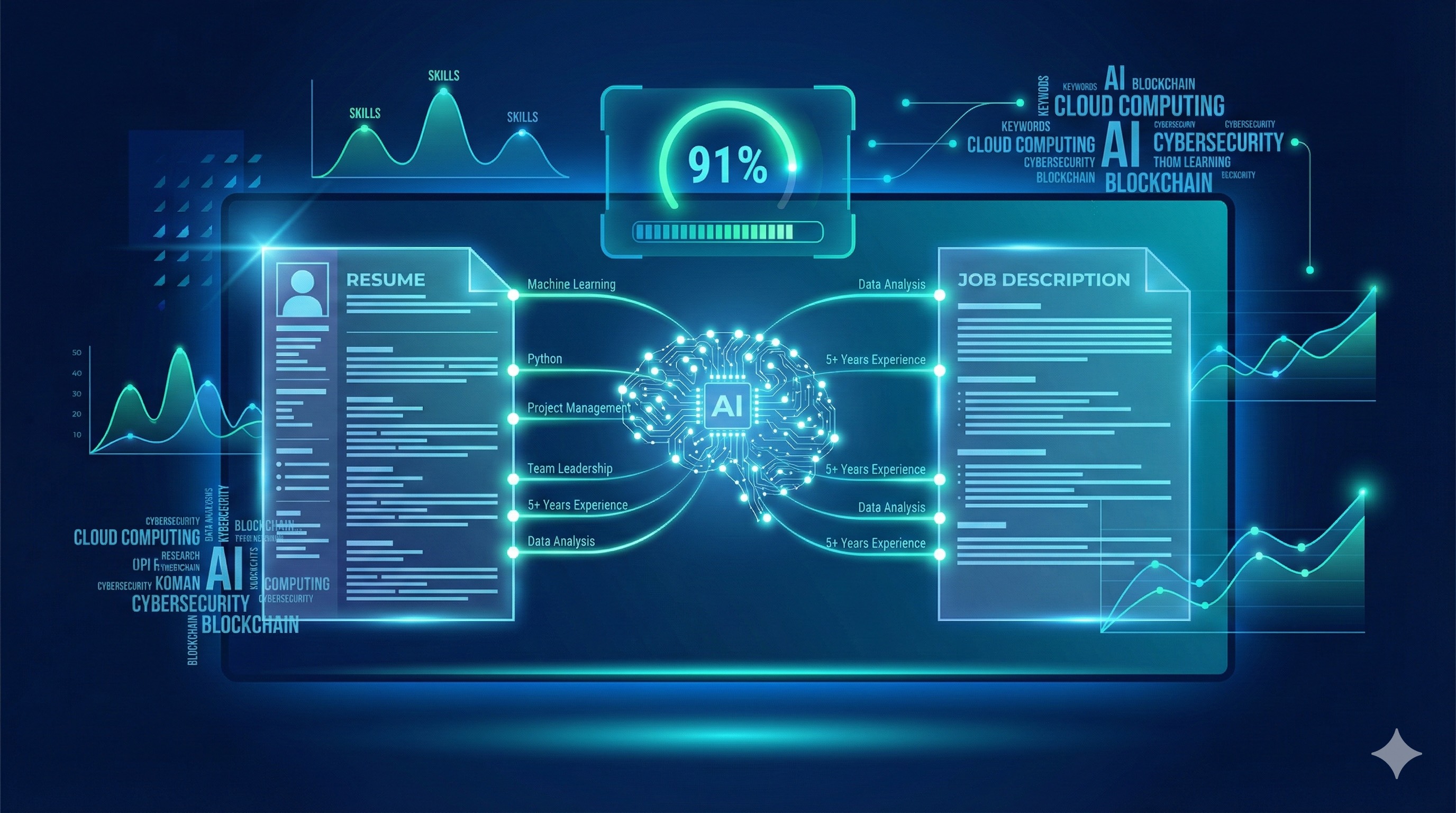
The most advanced tools — including CV by JD — provide a live ATS compatibility score that updates as you edit. You can see precisely how adding a specific keyword or restructuring a bullet impacts your match percentage before you submit.
Practical example:
A posting asks for "data-driven decision making." Your resume says "used analytics to inform strategy." An intelligent tool:
- Flags the gap
- Suggests adding "data-driven decision making" to your summary
- Recommends rewriting the bullet: "Made data-driven decisions on $2.4M ad spend using Google Analytics and Looker, reallocating budget to channels with 3.2x higher ROAS"
- Shows your ATS score improving from 62% to 87%
This is optimization with intelligence, not brute force.
Trend 2: Smart Bullet-Point Generation
The hardest part of resume writing isn't formatting — it's articulating what you actually accomplished in a way that's specific, quantified, and relevant to the target role.
AI bullet-point generators in 2026 solve three problems simultaneously:
Problem 1: The "Responsible for" Trap
Most people describe their jobs in terms of responsibilities, not achievements. AI tools trained on millions of successful resumes can take a vague input and transform it:
INPUT: "Responsible for managing the sales team"
AI OUTPUT (3 variants):
1. "Managed a 12-person sales team across 3 regions, exceeding quarterly targets by 18% and generating $4.2M in net-new revenue"
2. "Built and led a high-performing sales team of 12, reducing ramp time for new hires from 90 to 45 days while maintaining 115% quota attainment"
3. "Directed regional sales operations with P&L ownership of $8.5M, implementing a consultative selling framework that increased average deal size by 34%"
The value: Three distinct angles on the same experience. You pick the one that best matches the JD, or combine elements from multiple suggestions.
Problem 2: Metric Blindness
People routinely undercount their own metrics. AI tools now prompt you with targeted questions:
- "You mentioned managing a budget — what was the dollar amount?"
- "You mentioned improving a process — by what percentage?"
- "How many people were on the team you led?"
- "What was the timeline for this project?"
These prompts pull quantifiable details out of your memory that you'd otherwise leave on the table.
Problem 3: Tone Calibration
A bullet point for a VP of Engineering role should read differently from one for a Junior Developer role — even if the underlying achievement is similar. AI tools in 2026 adjust:
- Vocabulary complexity (strategic vs tactical language)
- Scope framing (company-level impact vs team-level)
- Leadership signals (directed, architected, championed vs built, contributed, supported)
Trend 3: Industry-Specific Customization
Generic AI writing tools (ChatGPT, Claude, Gemini) produce generic output. They don't know that a healthcare resume needs HIPAA compliance keywords, or that a finance resume should emphasize regulatory frameworks like SOX and Basel III.
The 2026 reality: Purpose-built resume AI tools are trained on industry-specific data. Here's what that enables:
Automatic Jargon Adaptation
The same "process improvement" achievement gets framed differently depending on the target industry:
- Manufacturing: "Implemented Lean Six Sigma methodology across 3 production lines, reducing defect rates from 4.2% to 0.8% and saving $620K annually"
- Healthcare: "Led PDSA cycle quality improvement initiative across 5 clinical departments, reducing patient wait times 31% while maintaining Joint Commission compliance"
- SaaS: "Redesigned onboarding workflow using product analytics data, reducing time-to-value from 14 days to 3 days and improving 90-day retention by 22%"
- Retail: "Optimized inventory replenishment process using demand forecasting model, reducing stockouts 47% and improving sell-through rate from 68% to 84%"
Cross-Industry Skill Translation
For career changers — a growing segment in 2026's volatile market — AI can translate skills from one industry's language to another's:
- Military → Corporate: "Platoon leadership of 40 personnel" becomes "Managed 40-person team across dispersed locations with $2M operational budget"
- Teaching → Corporate: "Designed curriculum for 150 students" becomes "Developed training programs for 150+ stakeholders with measurable learning outcomes"
- Hospitality → Tech: "Managed 200-seat restaurant operations" becomes "Directed high-volume operations serving 200+ daily customers, optimizing scheduling and inventory systems"
Regional and Market Customization
AI tools trained on global hiring data can adjust resume conventions for different markets:
- US: Achievement-focused, no photo, no personal info
- EU/DACH: May include photo, nationality, date of birth
- Middle East: Professional photo standard, comprehensive personal details
- UK: "CV" not "resume," references available upon request standard
Trend 4: Real-Time Market Intelligence
This trend matured rapidly through 2025 and is now a standard feature in leading tools by 2026.
Skill Gap Analysis
Advanced AI tools are beginning to compare your resume not just against one job description, but against market-wide demand data. The output:
- "Your resume matches 82% of Supply Chain Manager postings but only 34% of Operations Director roles. To bridge the gap, consider adding ERP system experience and P&L management."
- "Python and SQL appear in 78% of Data Analyst postings in your target market. Your resume mentions neither."
Salary Benchmarking
Some tools are integrating compensation data to help you understand whether your experience level aligns with the roles you're targeting — and whether you should be aiming higher:
- "Based on your 8 years of marketing experience and current skill set, comparable candidates in your metro area earn $95K–$125K. The role you're applying for lists $75K–$90K."
Trending Skills Radar
AI tools with access to real-time job posting data can identify which skills are growing in demand versus declining:
- Rising (2025–2026): AI/ML familiarity, data literacy, prompt engineering, cybersecurity fundamentals, ESG reporting, agentic AI workflows
- Stable: Project management, SQL, CRM platforms, financial modeling, stakeholder management
- Declining in job postings: Manual data entry, basic spreadsheet skills, "proficiency in Microsoft Office"
These insights let you make strategic decisions about which skills to highlight (and which to deprioritize) on your resume.
Trend 5: The Human + AI Balance
Here's what the hype cycle misses: AI-generated resumes still need human judgment.
Recruiters in 2026 are getting better at spotting pure AI output. A ResumeBuilder.com survey (updated January 2026) found that 62% of hiring managers said they can often identify AI-generated resumes — up from 53% a year earlier — and 41% said it negatively affects their perception of the candidate.
The winning formula is hybrid:
What AI Should Do
- Extract keywords from job descriptions
- Generate achievement bullet variants
- Validate ATS compatibility
- Suggest format and structure improvements
- Flag missing skills and gaps
What Humans Should Do
- Choose which achievements to highlight (strategic judgment)
- Add authentic voice and personality to the summary
- Verify all metrics and claims are accurate
- Decide which AI suggestions to accept and which to reject
- Tell the story of career transitions, promotions, and growth
The Authenticity Test
Read your AI-assisted resume out loud. If it sounds like you talking about your career at a networking event — natural, specific, and genuine — it's ready. If it sounds like a corporate press release or a generic LinkedIn post, it needs more human editing.
A practical workflow:
- Upload your current resume to an AI builder like CV by JD
- Paste the target job description
- Review the AI's keyword analysis and gap report
- Accept the structural suggestions and keyword placements
- Rewrite the summary in your own voice
- Verify every metric and achievement claim
- Read the final version out loud
- Submit
Time investment: 5–10 minutes per application with this hybrid approach — versus 20–30 minutes fully manual or 1–2 minutes fully automated (with quality risks).
Practical Action Plan: Using AI Resume Tools Effectively in 2026
For Job Seekers Just Starting
- Pick one purpose-built AI resume tool — not a general chatbot. Tools like CV by JD are designed specifically for job-description-to-resume matching.
- Upload your current resume as a starting point. AI works better with raw material than from scratch.
- Try it with 3 different job descriptions in your target area. Compare the outputs. You'll quickly see which keywords and achievements the market values most.
- Keep a "master achievement bank" — a document with every quantified win from your career. This gives AI better raw material to work with.
For Experienced Job Seekers
- Use AI for gap analysis, not just generation. The most valuable output is knowing what's missing, not getting a pre-written resume.
- A/B test your applications. Send AI-optimized versions to half your targets and manually optimized versions to the other half. Track callback rates over 2 weeks.
- Leverage industry-specific customization. If you're applying across industries (e.g., tech and healthcare), use AI to generate industry-appropriate variants from the same base experience.
For Career Changers
- Use AI skill translation to reframe your experience in the new industry's language
- Focus on transferable achievements — AI can identify which of your accomplishments map to your target industry's priorities
- Generate multiple framings of each achievement and test which resonates with the target audience
Try AI-powered resume optimization free with CV by JD →
What's Coming Next: Late 2026 and Beyond
Video Resume AI
Early tools are experimenting with AI-assisted video introductions — generating scripts, coaching delivery, and even providing teleprompter-style prompts during recording. Still niche, but growing in creative and sales roles.
Interview Prep Integration
The next logical step after resume optimization: AI that uses your tailored resume to generate likely interview questions and coach you on answers that align with your resume's narrative.
Continuous Profile Optimization
Instead of building a resume when you need a job, AI will continuously monitor your LinkedIn, project updates, and skill development — maintaining an always-ready, always-optimized professional profile.
Multi-Format Output
One input → resume, cover letter, LinkedIn summary, portfolio page, and email introduction — all tailored to the same job description and optimized for their respective platforms.
Frequently Asked Questions
Will hiring managers reject my resume if they know AI helped write it?
Most won't — if the content is authentic and specific to you. What triggers rejection is obviously generic, unverified, or template-sounding output. Use AI for structure and optimization; keep the substance yours.
Can AI tools really predict my ATS score?
The best tools provide reliable estimates based on keyword matching, format analysis, and scoring algorithms modeled on major ATS platforms. They're not 100% precise (each ATS weighs differently), but they're far more accurate than guessing.
Should I use AI for senior/executive resumes?
Yes, but with heavier human editing. Senior resumes need strategic narrative, board-level language, and carefully framed metrics. AI handles the optimization layer; you handle the positioning.
Is one AI resume tool enough, or should I use multiple?
Start with one purpose-built tool. Using multiple creates inconsistencies and wastes time. The value comes from the job-description-matching intelligence, not from cross-referencing five different AI outputs.
The Bottom Line
AI isn't replacing resume writing. It's replacing the most tedious, time-consuming parts of resume optimization — keyword extraction, ATS formatting, achievement quantification — and giving that time back to you for strategic decisions about your career narrative.
The job seekers winning in 2026 aren't the ones with the fanciest AI tools. They're the ones using AI for what it's good at (speed, pattern matching, optimization) and their own judgment for what it's not (authenticity, career strategy, personal storytelling).
The gap between AI-assisted and non-AI-assisted job seekers is widening. Whether you adopt these tools is still your choice. But understanding what they can do — and what the candidates competing against you are already using — is not optional.
Start optimizing your resume with AI — free with CV by JD →
Sources:
- W3Global — Smarter Resumes, Better Careers: The Role of AI in Resume Optimization (2024)
- BuildMyCV — AI Resume Trends That Will Dominate 2024 (2024)
- My Learning Curve — 5 AI Trends That Will Influence Your 2024 Job Search (Medium, 2024)
- Jobscan — Fortune 500 ATS Usage Statistics (2024)
- ResumeBuilder.com — Hiring Manager Survey on AI-Generated Resumes (January 2026)
- LinkedIn Talent Solutions — Global Talent Trends Report (2025)