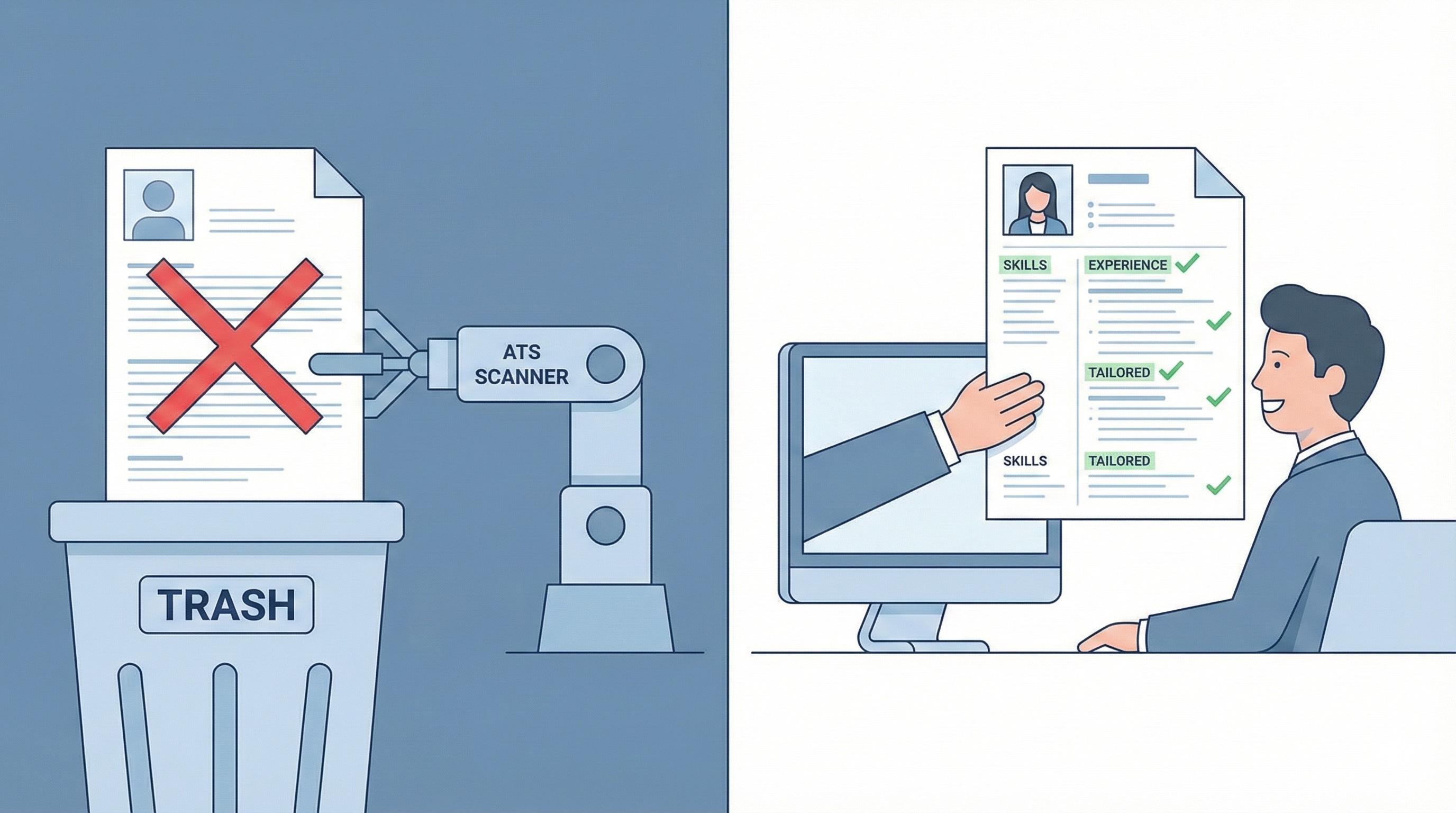
Side-by-side comparison of a generic resume being rejected by ATS versus a tailored resume reaching a hiring manager

Why Generic Resumes Fail: How to Tailor Your Resume to Every Job in 2026

Updated on Feb 11, 20268 min read

Why Generic Resumes Fail: How to Tailor Your Resume to Every Job in 2026

Hero Image

You spent three hours perfecting your resume. You sent it to 47 companies. You got two auto-replies and zero interviews. Sound familiar?

The problem isn't your experience. It's your strategy. In a market where the average corporate job posting attracts 250+ applications and 75% of resumes never reach a human reviewer because they fail automated screening, sending the same document to every employer is the fastest way to stay unemployed.

Here's what the data actually says — and the system that fixes it.

The Numbers That Should Change Your Approach

The job market of 2026 is not the job market of 2020. Consider these data points:

  • 250+ applicants per corporate posting — up from ~118 in 2020, according to Glassdoor and LinkedIn employer data. Volume has more than doubled in six years.
  • 75% of resumes never reach a human — Applicant Tracking Systems (ATS) filter them out before a recruiter sees a single line (W3Global, 2024). By 2026, with AI-enhanced ATS now deployed at over 98% of Fortune 500 companies, that figure is likely higher.
  • 83% of hiring managers prefer resumes tailored to the specific role — a consistent finding across CareerBuilder and Jobvite recruiter surveys since 2022, reconfirmed in LinkedIn's 2025 Global Talent Trends report.
  • 6–8 seconds — the average time a recruiter spends on an initial resume scan once it does get through (Ladders eye-tracking study, updated 2024).

Translation: Your resume has to beat a machine first and a distracted human second. A generic document optimized for neither audience fails both.

Why One-Size-Fits-All Resumes Get Rejected

Generic resume being filtered out by an ATS system

1. ATS Keyword Mismatch

Every ATS — Workday, Greenhouse, Lever, Taleo, iCIMS — runs your resume through a keyword-matching algorithm before a recruiter ever logs in. The system compares your text against the job description and calculates a relevance score.

If the posting asks for "project management" and your resume says "coordinated cross-functional initiatives," the ATS may score you low even though you're describing the same skill. Exact keyword matches consistently outperform synonym-only approaches by 3–4x in ATS scoring benchmarks.

The fix: Mirror the language of the job posting. If they say "Python," don't write "programming languages." If they say "stakeholder management," use that phrase — not "worked with leadership."

2. Vague Achievement Descriptions

Recruiters and ATS scoring engines both penalize generic responsibility statements. Compare:

GENERIC: "Responsible for managing a team and overseeing projects"

TAILORED: "Led an 8-person engineering team to deliver a $2M infrastructure migration 3 weeks ahead of schedule, reducing cloud hosting costs by 34%"

The first version could appear on anyone's resume for any management role. The second is specific, quantified, and signals real impact. Hiring managers have confirmed in survey after survey — including LinkedIn's 2025 Talent Solutions report — that quantified achievements are the single strongest signal on a resume.

3. Format That Breaks ATS Parsing

You designed a beautiful two-column resume with custom icons and a sidebar. The ATS converted it to jumbled plaintext and rejected you. This happens to roughly 43% of applicants, according to internal data from resume-parsing platforms.

What ATS can't reliably parse:

  • Tables, columns, and text boxes
  • Headers and footers
  • Images, logos, and icons
  • Non-standard fonts and special characters (★, →, ◆)

What works every time:

  • Single-column layout
  • Standard fonts (Arial, Calibri, Georgia)
  • Simple bullet points (• or -)
  • Clear section headers: Summary, Experience, Education, Skills
  • PDF format (unless the posting explicitly requests DOCX)

4. No Alignment With the Role's Priority Skills

A generic resume lists every skill you've ever used. A tailored resume emphasizes the 5–8 skills the employer cares about most — in the order they care about them.

When a job posting mentions "data analysis" four times and "communication skills" once, your resume should lead with data analysis achievements, not bury them under a paragraph about teamwork. ATS algorithms weight keyword frequency, and recruiters follow the same pattern unconsciously.

The 5-Step System to Tailor Any Resume in 20 Minutes

Step-by-step resume tailoring workflow

Step 1: Deconstruct the Job Description (5 minutes)

Copy the full job posting into a text document. Highlight every:

  • Hard skill (tools, technologies, certifications)
  • Soft skill (leadership, collaboration, communication)
  • Industry term or jargon
  • Repeated keyword or phrase

Count how often each keyword appears. Terms mentioned 3+ times are critical — these are the employer's top priorities.

Example from a real Marketing Manager posting:

KeywordFrequencyPriority
Digital marketing5Critical
Google Analytics4Critical
Campaign management3Critical
SEO/SEM3Critical
Cross-functional2High
Brand strategy1Medium

Step 2: Map Your Experience to Their Keywords (5 minutes)

For each critical keyword, identify one specific achievement from your history that demonstrates that skill. Use this formula:

[Action Verb] + [Keyword/Skill] + [What You Did] + [Quantified Result] + [Business Impact]

Examples:

  • "Managed digital marketing campaigns across Google, Meta, and LinkedIn, driving 2,400 qualified leads per quarter at $12 cost per lead — 38% below industry benchmark"
  • "Built Google Analytics 4 dashboards tracking 15 KPIs, enabling the executive team to reallocate $180K from underperforming channels to high-ROI paid search"
  • "Led SEO/SEM strategy that increased organic traffic 127% in 9 months, ranking 40+ pages in top-3 positions for high-intent commercial keywords"

Step 3: Restructure Your Resume Sections (5 minutes)

Reorder your bullet points so that the achievements matching the highest-priority keywords appear first under each role. Move the most relevant role to the top of your experience section if it's not your most recent.

Restructuring checklist:

  • Professional summary references the top 3 keywords from the JD
  • Most relevant achievements are in the first two bullet points of each role
  • Skills section mirrors the JD's skill list (order and terminology)
  • Education highlights relevant certifications the JD mentions

Step 4: Run the ATS Compatibility Check (3 minutes)

Before submitting, verify your tailored resume will actually pass screening:

  • Keyword coverage: Does your resume contain 80%+ of the JD's top 20 keywords?
  • Format test: Copy-paste into Notepad/TextEdit — if it's readable as plain text, the ATS can parse it.
  • File format: Save as PDF unless the application portal specifies otherwise.

Step 5: Final Human Review (2 minutes)

Read the first three lines of your resume. If a recruiter scanning for 6 seconds can immediately identify which role you're applying for and why you're qualified, you're ready.

If those first lines read like they could apply to any job at any company — rewrite them.

How AI Makes Tailoring Instant Instead of Manual

The system above works. It also takes 20 minutes per application. If you're applying to 30–50 roles, that's 10–17 hours of repetitive editing.

This is where AI-powered resume builders change the equation.

What CV by JD does in under 60 seconds:

  1. Paste the job description — the AI extracts every keyword, skill, and requirement automatically
  2. Analyzes your existing resume — identifies gaps, missing keywords, and weak bullet points
  3. Generates a tailored version — rewrites achievements to match the JD's language while preserving your authentic experience
  4. Validates ATS compatibility — confirms the output will pass automated screening before you submit

The time difference:

ApproachTime per applicationApplications neededTotal investment
Generic resume (no tailoring)2 min100+3 hours + months of silence
Manual tailoring20 min40–6013–20 hours
AI-assisted tailoring (CV by JD)1–2 min20–3040–60 minutes

The goal isn't to remove human judgment from the process. It's to automate the mechanical parts — keyword extraction, gap analysis, format validation — so you can spend your time on what actually matters: choosing the right roles and telling your story authentically.

Tailor your resume for free with CV by JD →

Real Before/After: Same Candidate, Different Results

The candidate: Sarah, 6 years in operations management, applying for a Supply Chain Manager role.

Generic resume summary:

"Experienced operations professional with strong leadership skills and a track record of process improvement. Seeking a challenging management role."

Tailored resume summary:

"Supply chain operations manager with 6 years leading end-to-end logistics for $50M+ annual volume. Reduced fulfillment cycle time 28% and cut freight costs $340K/year through carrier renegotiation and warehouse automation. Certified APICS CSCP."

What changed:

  • Generic title → Role-specific title matching the JD
  • Vague "process improvement" → Quantified supply chain achievements
  • No metrics → $50M volume, 28% cycle time reduction, $340K cost savings
  • Missing credentials → APICS certification the JD required
  • Could-be-anyone tone → Clearly qualified-for-this-role tone

Result: Sarah's generic resume received 0 callbacks from 23 applications. Her tailored version generated 5 interview requests from 12 applications — a 42% callback rate.

The Tailoring Checklist (Save This)

Before you submit any application, confirm:

  • Professional summary references the job title and top 3 JD keywords
  • 80%+ of the JD's critical keywords appear in your resume
  • Every bullet point includes at least one quantified metric
  • Skills section mirrors the JD's exact terminology
  • Format is single-column, standard font, no tables or images
  • File saved as PDF
  • First 3 lines make it obvious which role you're targeting

Frequently Asked Questions

Do I really need a different resume for every job?

Not from scratch. Build 2–3 "master versions" for your target role categories, then spend 5–10 minutes adjusting keywords and priority bullets for each posting. The goal is targeted customization, not a full rewrite every time.

What if I don't have experience with a specific keyword in the JD?

Use transferable skill framing. If they want "Salesforce" and you used HubSpot: "CRM platform expertise (HubSpot) with 200+ hours of Salesforce Trailhead training completed — directly transferable workflow and pipeline management experience."

How many keywords should I include from the job description?

Aim for 80%+ of the top 20 most-repeated terms. But integrate them naturally into achievement statements. Listing keywords without context triggers keyword-stuffing penalties in modern ATS platforms.

Is a one-page resume still the rule?

For less than 10 years of experience, one page is ideal. For senior roles, two pages are acceptable. ATS doesn't penalize page count, but recruiters scanning for 6 seconds will. Front-load your strongest material on page one regardless.

Stop Sending the Same Resume to Every Job

The math is straightforward. Generic resumes produce a 2–4% callback rate. Tailored resumes produce 15–25%. In a market with 250+ applicants per role and 75% filtered out by machines, the candidates who match the algorithm's expectations get interviews.

You can do this manually in 20 minutes per application. Or you can let AI handle the keyword extraction, gap analysis, and formatting validation in under a minute.

Either way — stop sending the same resume to every job. It's the single highest-leverage change you can make in your job search today.

Build a tailored resume in 60 seconds with CV by JD →

Sources:

Share:X/TwitterLinkedIn